The Road
The Road, primarily U.S. Highway 66, is the central artery of the Joad family's migration and the symbolic pathway of the Dust Bowl exodus in John Steinbeck's The Grapes of Wrath. It functions as both a literal route from Oklahoma to California and a powerful narrative device that structures the novel's journey, embodies the collective displacement of an entire people, and becomes the stage for the migrants' transformation from isolated individuals into a unified, conscious class.
Definition and Physical Reality
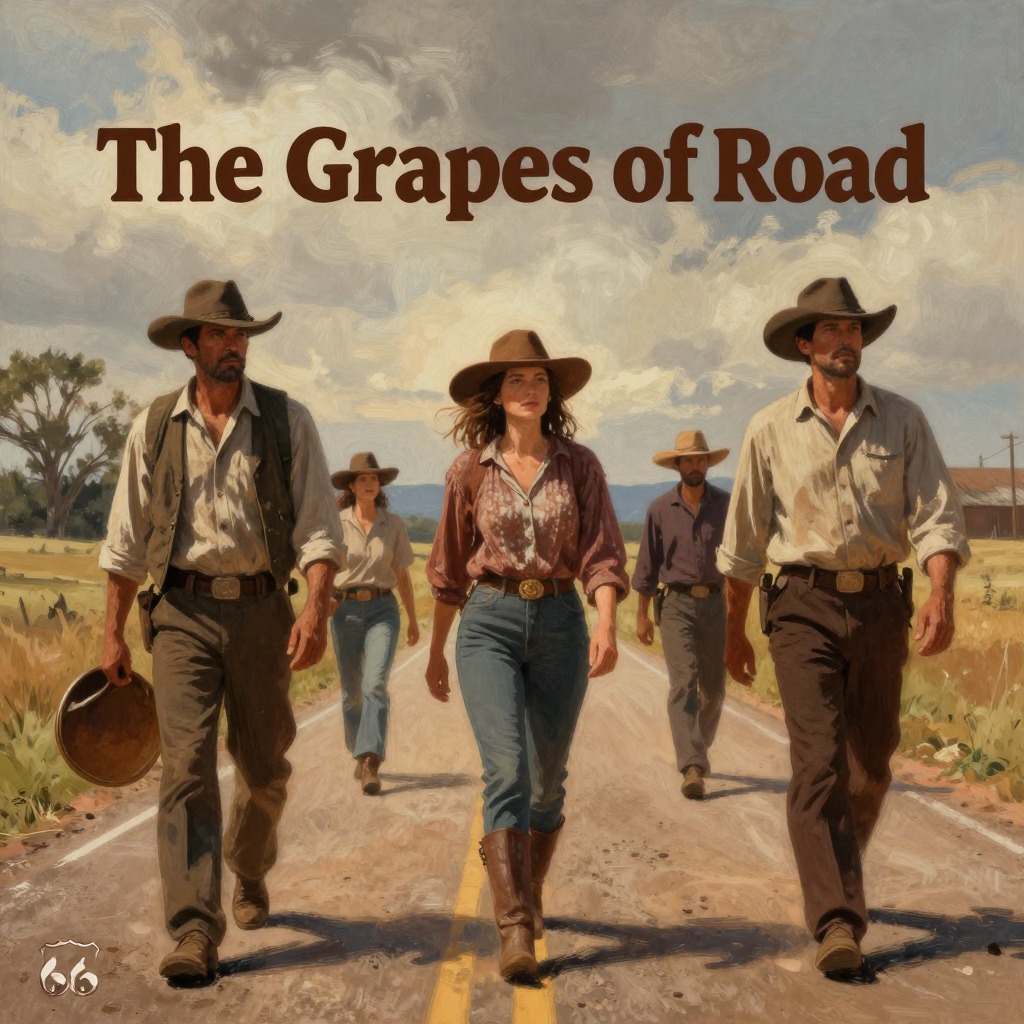
Highway 66 is introduced in chapter 12 as "the main migrant road" and "the mother road, the road of flight." It is a "long concrete path across the country, waving gently up and down on the map, from Mississippi to Bakersfield." The road traverses a vast geography: "over the red lands and the gray lands, twisting up into the mountains, crossing the Divide and down into the bright and terrible desert, and across the desert to the mountains again, and into the rich California valleys." Steinbeck meticulously catalogs the towns along its route—Clarksville, Ozark, Van Buren, Fort Smith, El Reno, Clinton, Hydro, Elk City, Texola, Shamrock, McLean, Conway, Amarillo, Tucumcari, Santa Rosa, Albuquerque, Los Lunas, Gallup, Holbrook, Winslow, Flagstaff, Ashfork, Kingman, Needles, Barstow—creating a litany of places that marks the migrants' progress and the immense scale of their journey. The road is the concrete manifestation of the migrants' flight "from dust and shrinking land, from the thunder of tractors and shrinking ownership, from the desert's slow northward invasion, from the twisting winds that howl up out of Texas, from the floods that bring no richness to the land and steal what little richness is there."
The Road as the New Home
For the Joads, the road becomes the new center of their existence. The family's ancient Hudson Super-Six truck, modified into a half-passenger, half-cargo vehicle, is described as "the new hearth, the living center of the family." The road itself replaces the farm as the locus of their lives. The novel states that "the highway became their home and movement their medium of expression." The family's daily concerns shift from the land to the vehicle and the road: "Eyes watched the tires, ears listened to the clattering motors, and minds struggled with oil, with gasoline, with the thinning rubber between air and road. Then a broken gear was tragedy. Then water in the evening was the yearning, and food over the fire. Then health to go on was the need and strength to go on, and spirit to go on. The wills thrust westward ahead of them, and fears that had once apprehended drought or flood now lingered with anything that might stop the westward crawling." The road imposes a new rhythm of life: travel by day, camp by night, and repeat. The family council, the central decision-making body, meets not in a house but "at the most important place, near the truck."
The Road as a Social Crucible
The road is not merely a route but a social space where the migrant community is forged. The novel describes how the cars of the migrant people "crawled out of the side roads onto the great cross-country highway, and then took the migrant way to the West." In the daylight they scuttled like bugs to the westward; as dark caught them, they clustered near shelter and water. Because they were "lonely and perplexed," they huddled together, talked, and shared their lives. The road thus becomes the site where the transformation from "I" to "we" occurs. The novel's intercalary chapter 14 explicitly identifies this process: "Here is the node, you who hate change and fear revolution. Keep these two squatting men apart; make them hate, fear, suspect each other. Here is the anlage of the thing you fear. This is the zygote. For here 'I lost my land' is changed; a cell is split and from its splitting grows the thing you hate—'We lost our land.'" The road, by bringing the migrants together, enables this crucial shift in consciousness.
The Road as a Site of Suffering and Exploitation
The road is also a place of immense hardship and predation. The migrants' cars are described as "limping along 66 like wounded things, panting and struggling." The novel details the constant mechanical failures: "ancient leaky radiators sent up columns of steam, loose connecting rods hammered and pounded." The road is lined with predatory businesses, particularly used-car lots and service stations, where the migrants are cheated. Chapter 7 exposes the cynical practices of used-car salesmen who see the migrants as easy marks: "Get 'em in a jalopy. Sock it to 'em!" The road is also policed by hostile forces. The novel mentions the "border patrol on the California line" and police who stop migrants, tear up their driver's licenses, and turn them back. The road thus becomes a gauntlet of exploitation and harassment.
The Road as a Symbol of Hope and Despair
For the migrants, the road is simultaneously a path of hope and a source of despair. It leads toward the promise of California, a land of "oranges" and "high wages" advertised in handbills. Yet the road also leads to the reality of Hoovervilles, starvation wages, and violent repression. The road's end is not a paradise but a continuation of struggle. The novel's final chapters show the Joads still on the road, still moving, still searching. The road, therefore, is not a destination but a permanent condition of displacement. It is the physical embodiment of the migrants' rootlessness and their relentless, often futile, pursuit of a better life. The road is the stage upon which the central drama of the novel—the struggle for survival and dignity in the face of systemic injustice—is played out.